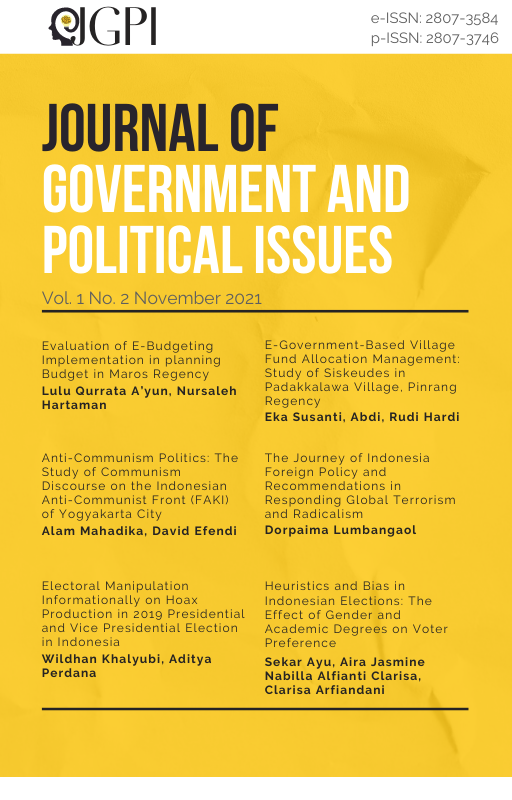
Anti-Communism Politics
The Study of Communism Discourse on the Indonesian Anti-Communist Front (FAKI) of Yogyakarta City
DOI:
https://doi.org/10.53341/jgpi.v1i2.20Keywords:
communism, study discourse, community organizationAbstract
This research tried to raise the issue of communism regarding anti-communist politics in the perception of the Indonesian Anti-Communist Front of Yogyakarta City and its strategy to understand and the movement of communism. This field research with a qualitative approach in this research is outlined using qualitative descriptive methods. The research findings showed that the Indonesian Anti-Communist Front of Yogyakarta City has a strategy of resistance to communism by organizing rallies and even rallies always collaborating with other nationalist community organizations. FAKI Yogyakarta also always holds an annual event that commemorates Pancasila day by watching G30S/PKI films together to grow the nation's knowledge, especially the younger generation of strategy. The next is to oversee discussions that smell communist and views on politics and religion, The Discourse of the Indonesian Anti-Communist Front Yogyakarta city given the political movement of communism is In the power struggle my words about the Indonesian Communist Party is the goal of justifying various ways to achieve the desire for power (Politics), the goal of justifying all means. The discourse of the Indonesian Anti-Communist Front of Yogyakarta city views communist social viewpoints and beliefs consistent with its historical methods. Communists view religion as a result of the history of human development. Based on historical materialism, the beginning of religion was designed by man as an institution containing all aspects of goodness, beauty, justice, and the realm of Communists viewing religion as a human creation. Religion is an imaginary world. Communism, which has a very heinous problem with theology, causes distrust of God and even causes them to be anti-God, anti-Religion, and even aggressive towards religious groups. But part of the Indonesian Communist Party cadre is Islamic, so what the Indonesian Anti-Communist Front says does not represent a diverse reality about PKI and communism.
Downloads
References
Andira. (2020). Front Anti Komunis Jawa Timur Menolak RUU HIP. Retrieved June 2, 2021, from suarakarya.id website: https://www.suarakarya.id/detail/112724/Front-Anti-Komunis-Jawa-Timur-Menolak-RUU-HIP
BBCnews. (2017). Polisi dan Ormas Cegah Seminar 1965 di LBH Jakarta. Retrieved June 20, 2021, from BBC News Indonesia website: https://www.bbc.com/indonesia/indonesia-41290897
Budiawan. (2004). Mematah Pewarisan Ingatan Wacana Anti-Komunis dan Politik Rekonsiliasi Pasca Soeharto. Jakarta: ELSAM – Lembaga Studi dan Advokasi Masyarakat.
CNN Indonesia. (2020). Puluhan Orang Gelar Aksi Ganyang PKI di Titik Nol Yogyakarta. Retrieved June 20, 2021, from CNN Indonesia website: https://www.cnnindonesia.com/nasional/20200706161658-20-521451/puluhan-orang-gelar-aksi-ganyang-pki-di-titik-nol-yogyakarta
Goodfellow, R. W. (2003). Sing Wis, Ya Wis: what is past is past. Forgetting what it was to remember the Indonesian killings of 1965 (University of Wollongong). University of Wollongong. Retrieved from https://ro.uow.edu.au/cgi/viewcontent.cgi?article=2425&context=theses
Hardiman, F. B. (2009). Demokrasi Deliberatif: Menimbang “Negara Hukum”dan "Ruang Publik " dalam Teori Khusus Diskursus Jurgen Habernas. Yogyakarta: Kanisius.
Harminanto. (2020). Ormas di Yogya Kembali Aksi, Minta RUU HIP Dibatalkan. Retrieved June 20, 2021, from https://www.krjogja.com/berita-lokal/diy/yogyakarta/ormas-di-yogya-kembali-aksi-minta-ruu-hip-dibatalkan/
Kusuma, D. (2010). Strategi Dakwah Front Pembela Islam dalam Menanggulangi Dampak Negatif Globalisasi (Universitas Islam Negeri Syarif Hidayatullah). Universitas Islam Negeri Syarif Hidayatullah. Retrieved from https://repository.uinjkt.ac.id/dspace/bitstream/123456789/21466/1/DODIANA KUSUMA-FDK.pdf
Kusumadewi, A. (2013). Alasan Front Anti-Komunis Bubarkan Diskusi di Yogya. Retrieved June 20, 2021, from viva.co.id website: https://www.viva.co.id/arsip/454317-alasan-front-anti-komunis-bubarkan-diskusi-di-yogya
Masridwan. (2019). Strategi Dakwah Majelis Cabang Nahdlatul Ulama Dalam Menanggulangi Paham Radikal Di Kecamatan Curahdami Kabupaten Bondowoso. Institut Agama Islam Negeri Jember.
McCarthy, T. (1994). Kantian Constructivism and Reconstructivism: Rawls and Habermas in Dialogue. Ethics, 105(1), 44–63. https://doi.org/10.1086/293678
McGregor, K. E. (2002). Commemoration of 1 October, Hari Kesaktian Pancasila: A Post-Mortem Analysis? Asian Studies Review, 26(1), 39–72. https://doi.org/10.1080/10357820208713330
Miles, M. B., Huberman, A. M., & Saldaña, J. (2014). Qualitative Data Analysis (Edition 3). Los Angles: Arizona State University.
Munthe, A. P. (2015). Pemberlakuan Ketetapan MPRS No XXV Tahun 1966 Dalam Kerangka Undang-undang No 12 Tahun 2005 Tentang Pengesahan Kovenan Internasiona Tentang Hak-hak Sipil dan Politik Berdasarkan Undang-undang Dasar Negara Republik Indonesia. Universitas Jember.
Nadira, F. (2021). Sejarah Hari Ini: Rezim Khmer Merah Digulingkan. Retrieved June 20, 2021, from republika.co.id website: https://www.republika.co.id/berita/qmjecl459/sejarah-hari-ini-rezim-khmer-merah-digulingkan
Narto. (2020). Aksi Ormas di Daerah Istimewa Yogyakarta Menentang Bangkitnya Komunis. Retrieved June 20, 2021, from Buser Online News website: https://buseronlinenews.com/2020/05/20/aksi-ormas-di-daerah-istimewa-yogyakarta-menentang-bangkitnya-komunis/
Novianto, A., Kurniawan, L., & Wibawa, S. (2018). Dinamika Gerakan Partai Rakyat Demokratik (PRD) di Indonesia: Analisis Perspektif Pelopor dan Partai Kiri Luas. Jurnal Penelitian Politik, 15(1), 31–48. https://doi.org/10.14203/jpp.v15i1.731
Nugroho, R. Y. Y. (2014). Pemikiran Ekonomi Dari Lenin, Revolusioner, dan Kiri Baru Serta Relevansinya Di Indonesia Saat Ini. Media Trend, 9(1), 1–27. https://doi.org/10.21107/mediatrend.v9i1.767
Prabowo, K. W. (2020). Sejumlah Ormas Serukan Ikrar Antikomunis. Retrieved June 20, 2021, from medcom.id website: https://www.medcom.id/nasional/politik/Rb102JzN-sejumlah-ormas-serukan-ikrar-antikomunis
Rachmawati, F. (2020). Kritik terhadap Konsep Ideologi Komunisme Karl Marx. Jurnal Sosiologi Agama Indonesia (JSAI), 1(1), 66–78. https://doi.org/10.22373/jsai.v1i1.424
Rosser, A. (2007). Escaping the resource curse: The case of Indonesia. Journal of Contemporary Asia, 37(1), 38–58. https://doi.org/10.1080/00472330601104557
Sekhu, A. (2018). Pasca Reformasi, PKI Dapat Angin Baru dan Bangkit Lagi. Retrieved June 20, 2021, from Cendana News website: https://www.cendananews.com/2018/09/pascareformasi-pki-dapat-angin-baru-dan-bangkit-lagi.html
Tarifa, F., & Weinstein, J. (1995). Overcoming the Past: De-Communization and Reconstruction of Post-Communist Societies. Studies In Comparative International Development, 30(4), 63–77. https://doi.org/10.1007/BF02687160
Wicaksono, G. A. (2020). Gerakan Kiri di Yogyakarta Tahun 1950-1965. Walasuji : Jurnal Sejarah Dan Budaya, 11(2), 273–289. https://doi.org/10.36869/wjsb.v11i2.151
Yando, A. P., Muradi, M., & Ali, Y. (2019). Strategi Organisasi Kepemudaan Sapma Pemuda Pancasila DKI Jakarta Dalam Kontra Radikalisme. Peperangan Asimetrik, 5(1), 65–80. Retrieved from http://jurnalprodi.idu.ac.id/index.php/PA/article/view/369/347
Downloads
Published
How to Cite
Issue
Section
License
Authors retain copyright and grant the journal right of first publication with the work simultaneously licensed under an Attribution 4.0 International (CC BY 4.0) that allows others to share — copy and redistribute the material in any medium or format and adapt — remix, transform, and build upon the material for any purpose, even commercially with an acknowledgment of the work's authorship and initial publication in this journal.