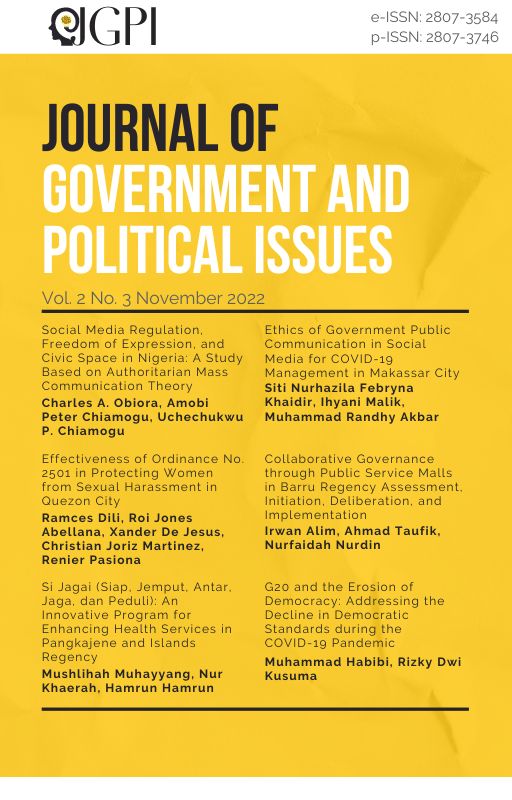
Social Media Regulation, Freedom of Expression, and Civic Space in Nigeria
A Study Based on Authoritarian Mass Communication Theory
DOI:
https://doi.org/10.53341/jgpi.v2i3.69Keywords:
social media regulation, digitalization, repression, gagging of the press, rule of law, autocratization, NigeriaAbstract
This study investigates the impact of the digital revolution on freedom of expression and civic space in Nigeria, particularly examining the role of social media regulation in the country's shift towards autocratization. Employing secondary data sources, the research focuses on key variables, including the government's approach to online content regulation, social media shutdowns, and capacity to regulate online content. The analysis reveals that the government's attempts to control the new media space go beyond silencing the press to outright repression, leading Nigeria towards authoritarianism characterized by reactionary tendencies. Moreover, the study finds that the combination of excessive social media regulation, a suppressed judiciary, and a weakened legislature may result in authoritarian rule in Nigeria. The paper concludes that disobedience to court orders and the use of state institutions against political opposition contribute to the erosion of democracy, highlighting the importance of a balanced approach to social media regulation to protect freedom of expression and maintain a democratic society.
Downloads
References
Affoah, V. (2018). Nigeria and the Obsession to Regulate Social Media. Retrieved from mfwa.org website: https://www.mfwa.org/issues-in-focus/nigeria-and-the-obsession-to-regulate-social-media/
Agwuegbo, C. (2021). Reclaiming Nigeria’s Shrinking Online Civic Space A Collective and Sustainable Civil Society Approach to Protect Liberties Chioma Agwuegbo About the Report. Retrieved from https://yaraduafoundation.org/files/Reclaiming Nigeria’s Shrinking Online Space.pdf
Baek, Y. M., Wojcieszak, M., & Delli Carpini, M. X. (2012). Online Versus Face-to-Face Deliberation: Who? Why? What? With What Effects? New Media and Society, 14(3), 363–383. https://doi.org/10.1177/1461444811413191
Bajracharya, S. (2018). Authoritarian Theory of Mass Communication. Retrieved from businesstopia.net website: https://www.businesstopia.net/mass-communication/authoritarian-theory-mass-communication
Bakare, T. (2020). Despite Evidence, Lai Mohammed Denies Existence of ‘Social Media Bill.’ Retrieved from The Guardian website: https://guardian.ng/news/nigeria/national/despite-evidence-lai-mohammed-denies-existence-of-social-media-bill/
Bakshy, E., Messing, S., & Adamic, L. A. (2015). Supporting Materials for Exposure to Ideologically Diverse News and Opinion on Facebook. Science, 348(6239), 1130–1132. https://doi.org/10.1126/science.aaa1160
Bekafigo, M. A., & McBride, A. (2013). Who Tweets About Politics?: Political Participation of Twitter Users During the 2011 Gubernatorial Elections. Social Science Computer Review, 31(5), 625–643. https://doi.org/10.1177/0894439313490405
Buhari, M. (2019). Independence Day Speech. Retrieved from Punch website: https://punchng.com/full-text-independence-day-speech-by-president-buhari/
Busari, K. (2019). Buhari Declines Assent to Digital Rights Bill, Four Others. Retrieved from Premium Times website: https://www.premiumtimesng.com/news/headlines/321189-buhari-%09declines-assent-to-digital-rights-bill-four-others.html
Chiefe, U. (2019). President Buhari’s Independence Day Speech May Suggest His Stance on Internet Censorship in Nigeria. Retrieved from Techpoint Africa website: https://techpoint.africa/2019/10/04/buhari-internet-censorship-nigeria/
Cohen-Almagor, R. (2017). J.S. Mill’s Boundaries of Freedom of Expression: A Critique. In Philosophy (Vol. 92). https://doi.org/10.1017/S0031819117000213
D’Arcy, P. (2017). Why Freedom of the Press is More Important Now Than Ever. Retrieved from ideas.ted.com website: https://ideas.ted.com/why-freedom-of-the-press-is-more-important-now-than-ever/
Dambo, T. H., Ersoy, M., Auwal, A. M., Olorunsola, V. O., Olonode, A., Arikewuyo, A. O., & Joseph, A. (2022). Nigeria’s #EndSARS Movement and Its Implication on Online Protests in Africa’s Most Populous Country. Journal of Public Affairs, 22(3), 1–11. https://doi.org/10.1002/pa.2583
Dierksmeier, C. (2019). Qualitative Freedom - Autonomy in Cosmopolitan Responsibility. In Qualitative Freedom - Autonomy in Cosmopolitan Responsibility. German: Transcript Qualitative Freiheit – Selbstbestimmung. https://doi.org/10.1007/978-3-030-04723-8
Ekoh, P. C., & George, E. O. (2021). The Role of Digital Technology in the EndSars Protest in Nigeria During COVID-19 Pandemic. Journal of Human Rights and Social Work, 6(2), 161–162. https://doi.org/10.1007/s41134-021-00161-5
Ekwealor, V. (2019). Nigeria’s President Refused to Sign its Digital Rights Bill, What Happens Now? Retrieved from Techpoint Africa website: https://techpoint.africa/2019/03/27/nigerian-president-declines-digital-rights-bill-assent/
Gilbert, P. (2021). Nigerian Internet and Mobile Penetration Grows. Retrieved from Connecting Africa website: https://www.connectingafrica.com/author.asp?section_id=761&doc_id=767400
Graber, D. A. (2015). Freedom of the Press : Theories and Realities. Oxford Handbooks Online, 1–14. https://doi.org/10.1093/oxfordhb/9780199793471.013.80
Ibezim-Ohaeri, V. (2017). Confronting Closing Civic Spaces in Nigeria. Sur: International Journal of Human Rights, 14(26), 129–140. Retrieved from https://sur.conectas.org/en/confronting-closing-civic-spaces-in-nigeria/
Jimada, U. (2019). Social Media in the Public Sphere of Accountability in Nigeria. Global Media Journal, 17(32), 178. Retrieved from https://www.globalmediajournal.com/open-access/social-media-in-the-public-sphere-of-accountability-in-nigeria.pdf
Kalu, U. C. (2018). Separation of Powers in Nigeria: an Anatomy of Power Convergences and Divergences. Nnamdi Azikiwe University Journal of International Law and Jurisprudence, 9(1), 116–126. Retrieved from https://www.ajol.info/index.php/naujilj/article/view/168811
Kemp, S. (2021). Digital 2021: Nigeria. Retrieved from DataReportal website: https://datareportal.com/reports/digital-2021-nigeria
Khalyubi, W., & Perdana, A. (2021). Electoral Manipulation Informationally on Hoax Production in 2019 Presidential and Vice Presidential Election in Indonesia. Journal of Government and Political Issues, 1(2), 87–99. https://doi.org/10.53341/jgpi.v1i2.17
Love, K. (2021). The Year In Press Freedom: 10 Urgent Cases Of Journalism Under Attack. Retrieved from Forbes website: https://www.forbes.com/sites/katherinelove/2021/01/04/the-year-in-press-freedom-10-urgent-cases-of-journalism-under-attack/?sh=6bb2c54c6d0d
Miles, M. B., Huberman, A. M., & Saldaña, J. (2014). Qualitative Data Analysis (Edition 3). Los Angles: Arizona State University.
Mohammed, A. (2021). Regulating Social Media in Nigeria: A Quantitative Perception Study. Nile Journal of Political Science, 2(1). https://doi.org/10.20321/njps.2021.01.03
Ndinojuo, B.-C. E., & Udoudo, A. (2018). A Converted Democrat? Profiling the Attacks on Nigerian Journalists During Buhari’s Civilian Regime (2015-2017). Covenant Journal of Communication (CJOC) An Open Access Journal, 5(1), 1–21. Retrieved from https://journals.covenantuniversity.edu.ng/index.php/cjoc/article/viewFile/996/661
Okoro, N., & Odii, C. (2013). Freedom of Information: Legislation, Implementation and Enforcement. Lagos: St Benedette publishers.
Olaniran, B., & Williams, I. (2020). Social media effects: Hijacking democracy and civility in civic engagement. In J. Jones and M. Trice (Eds.). Platforms, Protests, and the Challenge of Networked Democracy, Rhetoric, Politics and Society, 77–94. https://doi.org/10.1007/978-3-030-36525-7_5
Oyekanmi, A. A., & Rosenje, M. O. (2022). Challenges and Prospects of National Security, Legitimacy, and Democratic Sustenance in Nigeria’s Fourth Republic. Journal of Government and Political Issues, 2(2), 110–116. https://doi.org/10.53341/jgpi.v2i2.73
Paul, E. (2019). Everything You Need to Know About Nigeria’s Social Media Bill and What You Can Do About It. Retrieved from Techpoint Africa website: https://techpoint.africa/2019/11/28/nigerias-social-media-bill/
Raman, S. (2020). Attacks on the Press Track a Democratic Backslide: As Press Freedom Declines Globally, the United States Must Reckon with its Own Diminishment. Retrieved from Foreign Policy website: https://foreignpolicy.com/2020/06/29/press-freedom-decline-attacks-george-floyd-protests/
Sloss, D. L. (2019). Weaponization of Social Media by Authoritarian States. Retrieved from Markkula Centre for Applied Ethics website: https://www.scu.edu/ethics-spotlight/social-media-and-democracy/weaponization-of-social-media-by-authoritarian-states/
Suntai, D. I., & Targema, T. S. (2018). New Media and Democracy in Nigeria: an Appraisal of the Opportunities and Threats in the Terrain. Revista Brasileira de Estudos Africanos, 2(4), 198–209. https://doi.org/10.22456/2448-3923.78013
Uwalaka, T. (2022). Social Media as Solidarity Vehicle During the 2020 #EndSARS Protests in Nigeria. Journal of Asian and African Studies, 00219096221108737. https://doi.org/10.1177/00219096221108737
Uwazuruike, A., & Raphael, O. (2020). #EndSARS: The Movement Against Police Brutality in Nigeria. Harvard Human Rights Journal. Retrieved from http://clok.uclan.ac.uk/35527/
V-Dem Institute. (2021). Autocratization Turns Viral: Democracy Report 2021. Retrieved from https://www.v-dem.net/static/website/files/dr/dr_2021.pdf
Velasquez, A., & Rojas, H. (2017). Political Expression on Social Media: The Role of Communication Competence and Expected Outcomes. Social Media and Society, 3(1). https://doi.org/10.1177/2056305117696521
Downloads
Published
How to Cite
Issue
Section
License
Copyright (c) 2022 Charles A. Obiora, Amobi Peter Chiamogu, Uchechukwu P. Chiamogu

This work is licensed under a Creative Commons Attribution 4.0 International License.
Authors retain copyright and grant the journal right of first publication with the work simultaneously licensed under an Attribution 4.0 International (CC BY 4.0) that allows others to share — copy and redistribute the material in any medium or format and adapt — remix, transform, and build upon the material for any purpose, even commercially with an acknowledgment of the work's authorship and initial publication in this journal.