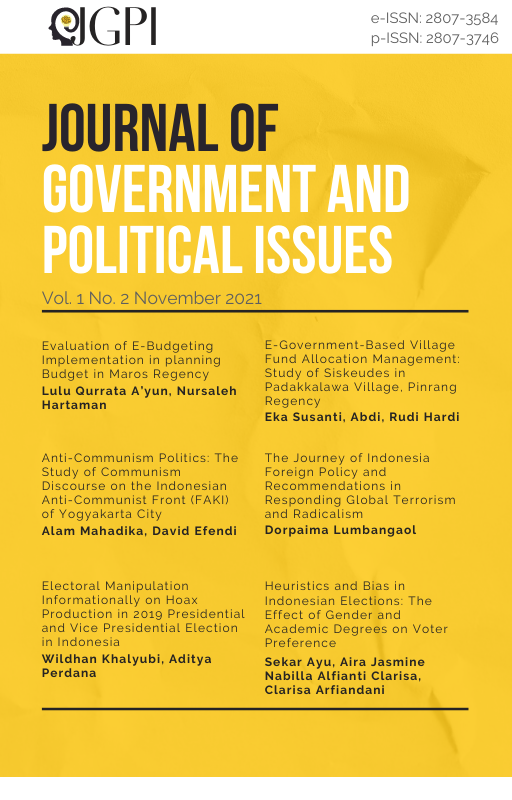
Evaluation of E-Budgeting Implementation in Planning Budget in Maros Regency
DOI:
https://doi.org/10.53341/jgpi.v1i2.22Keywords:
budgeting system, e-budgeting, development of technologyAbstract
Several Regional Governments then implemented E-Budgeting in the preparation of the budget. One region that has implemented E-Budgeting in preparing regional budgets is Maros Regency. The research in this paper was conducted by reviewing literature, articles and using secondary data with documentation from observations via the internet. The data was obtained by monitoring the government website and the application used by the Maros Regency Government in conducting the E-Budgeting process and then conducting a descriptive qualitative analysis. The results of the study show that evaluation of the implementation of the E-Budgeting System in Budgeting in Maros Regency can be stated that at this time the electronic-based budgeting system has been implemented well but has not been fully optimal in achieving the results and benefits, this can be seen in 6 (six) criteria in the evaluation, namely effectiveness, efficiency, adequacy, equity, and responsiveness.
Downloads
References
Adam, C., Hurka, S., Knill, C., & Steinebach, Y. (2019). Policy accumulation and the democratic responsiveness trap. Cambridge University Press.
Andhayani, A. (2020). Sistem Informasi Pemerintahan Daerah: E-Budgeting untuk Mewujudkan Akuntabilitas Pemerintah Daerah. Jurnal Riset Dan Aplikasi: Akuntansi Dan Manajemen, 4(2), 183–193.
Creswell, J. W. (2016). “Research Design. Pendekatan Metode Kualitatif, Kuantitatif, dan Campuran. Edisi keempat.”. Yogyakarta: Pustaka Pelajar.
Derbeneva, V., & Starodubets, N. (2021). The Impact of Digitalization on the Initiative Budgeting Processes. XV International Conference" Russian Regions in the Focus of Changes"(ICRRFC 2020), 14–20. Atlantis Press.
Dunn, W. (2003). Analisa KebijakanPublik. Yogyakarta: PT. Bumi Aksara.
Fernandez-Cortez, V., Valle-Cruz, D., & Gil-Garcia, J. R. (2020). Can Artificial Intelligence Help Optimize the Public Budgeting Process? Lessons about Smartness and Public Value from the Mexican Federal Government. 2020 Seventh International Conference on EDemocracy & EGovernment (ICEDEG), 312–315. IEEE.
Gunawan, Rizki, D. (2016). Penerapan Sistem E-Budgeting Terhadap Transparansi dan Akuntabilitas Keuangan Publik (Studi Pemkot Surabaya). Jurnal Akrual, 8(1), 72–102. https://doi.org/2502-6380
Hakim, A., Saputra, O. A., & Saleh, C. (2021). Policy Determination in E-Budgeting Implementation by the Government of DKI Jakarta–Indonesia. International Journal of Criminology and Sociology, 10, 149–167.
Hamrun, H., Harakan, A., Prianto, A. L., & Khaerah, N. (2020). Strategi Pemerintah Daerah Dalam Pengembangan Pelayanan Berbasis E-Government Di Kabupaten Muna. Nakhoda: Jurnal Ilmu Pemerintahan, 18(2), 64.
Harakan, A., Nur, S., Mustari, N., & Dyussenov, M. (2020). Effect of E-Procurement Implementation on the Procurement Accountability of Health Facilities in Bantaeng, Indonesia. Proceedings of the 1st International Conference on Environmental Governance, ICONEG 2019, 25-26 October 2019, Makassar, South Sulawesi, Indonesia. EAI. https://doi.org/10.4108/eai.25-10-2019.2300724
Jayasinghe, K., Adhikari, P., Carmel, S., & Sopanah, A. (2020). Multiple rationalities of participatory Budgeting in indigenous communities: evidence from Indonesia. Accounting, Auditing & Accountability Journal.
Khoirunnisak, R. (2017). Penerapan E-Budgeting Pemerintah Kota Surabaya dalam Mencapai Good Governance. Prosiding Semnas Ekonomi Dan Bisnis, 27–28.
Kurrohman, T. (2013). Evaluasi Penganggaran Berbasis Kinerja Melalui Kinerja Keuangan Yang Berbasis Value For Money. Jurnal Dinamika Akuntansi, 5(1), 1–11.
Lejiu, A. (2009). Evaluasi Kebijakan Pembangunan Transmigrasi Di Kabupaten Mahakam Ulu. Jurnal Administrative Reform, 2(4), 515–526.
Napitupulu, D. (2015). Kajian Faktor Sukses Implementasi E-Government Studi Kasus: Pemerintah Kota Bogor. Jurnal Sistem Informasi, 5(3), 229–236. https://doi.org/10.24089/j.sisfo.2015.03.009
Nkya, N. J. (2019). The effect of E-Budgeting in the financial performance of lower local government authorities: The case of Dodoma city. The University of Dodoma.
Nugraha, A. Y., & Wibowo, U. B. (2020). Analysis of Benefits and Obstacles from E-Budgeting Implementation in Educational Organizations. International Conference on Educational Research and Innovation, 401(65), 1–5.
Permatasari, I. A. (2020). Kebijakan Publik (Teori, Analisis, Implementasi Dan Evaluasi Kebijakan). TheJournalish: Social and Government, 1(1), 33–37.
Prayoga, F. M., & Yuhertiana, I. (2021). Studi Literatur Faktor yang Mempengaruhi Implementasi E-Budgeting dalam Sektor Publik. JPSI (Journal of Public Sector Innovations), 5(2), 68. https://doi.org/10.26740/jpsi.v5n2.p68-79
Setyawan, W., & Gamayuni, R. R. (2020). The Quality of Financial Reporting and Internal Control System before and after the Implementation of E-Budgeting in Indonesia Local Government. Asian Journal of Economics, Business and Accounting, 14(3), 22–31.
Sosiawan, E. (2008). Tantangan Dan Hambatan Dalam Implementasi E-Government Di Indonesia. Seminar Nasional Informatika, 99–108. https://doi.org/1979-2328
Stratu-Strelet, D., Gil-Gómez, H., Oltra-Badenes, R., & Oltra-Gutierrez, J. V. (2021). Critical factors in the institutionalization of e-participation in e-government in Europe: Technology or leadership? Technological Forecasting and Social Change, 164, 120489.
Sutama, I. N. (2017). Analisis Efisiensi , Efektivitas dan Kontribusi Pajak Hotel dan Restoran. Jurnal Ekonomi Dan Bisnis, 14(3), 256–272.
Woolf, N. H., & Silver, C. (2018). Qualitative Analysis Using Nvivo, The Five Level QDA Method. In Routledge. New York and London: Routledge.
Downloads
Published
How to Cite
Issue
Section
License
Authors retain copyright and grant the journal right of first publication with the work simultaneously licensed under an Attribution 4.0 International (CC BY 4.0) that allows others to share — copy and redistribute the material in any medium or format and adapt — remix, transform, and build upon the material for any purpose, even commercially with an acknowledgment of the work's authorship and initial publication in this journal.